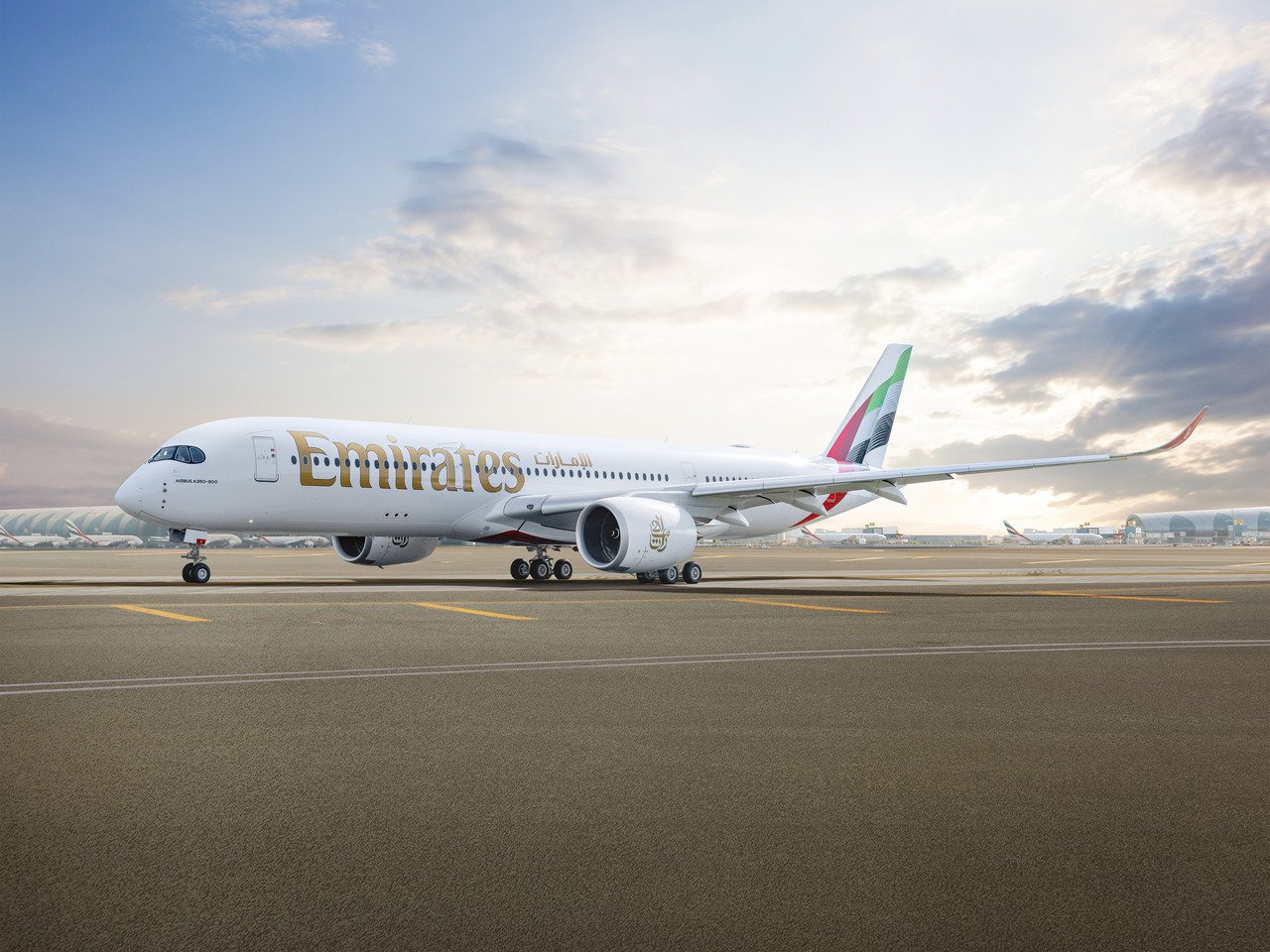
A Milestone Route Gets a New Aircraft
Emirates has rolled out its newest widebody aircraft, the Airbus A350, on one of its longest-running Southeast Asian routes, introducing daily A350 service between Dubai and Kuala Lumpur. The move adds the airline’s latest cabin products to a route that has connected the two cities for three decades, marking a symbolic pairing of new technology with an established partnership.
The A350 now operates flights EK344 and EK345, joining a retrofitted Boeing 777 that continues to serve the route on EK346 and EK347. Together, the two aircraft types have expanded Emirates’ daily Premium Economy capacity on the Dubai-Kuala Lumpur corridor to 52 seats, giving travellers on one of the airline’s most established Asian routes considerably more choice than they’ve had in years past.
Inside the New Aircraft
For passengers accustomed to Emirates’ existing fleet, the A350 introduces a noticeably different onboard experience. The configuration includes 32 lie-flat Business Class seats arranged in a 1-2-1 layout, allowing direct aisle access for every Business Class passenger — a meaningful upgrade in an industry where aisle access has become an important differentiator for premium travellers. Behind Business Class sits 28 Premium Economy seats, followed by 238 seats in Economy Class, bringing the aircraft’s total capacity to 298.
The cabin experience extends beyond seating. The A350 features Emirates’ latest ice inflight entertainment system, complete with 4K and 4K HDR displays, along with wireless charging available in Business Class. Connectivity has also been upgraded, with Wi-Fi powered by Viasat’s Global Xpress satellite network, a system designed to deliver more consistent, higher-bandwidth connectivity throughout the flight than older satellite-based systems typically manage.
Part of a Broader Fleet Transition
The Kuala Lumpur deployment is one small piece of a much larger transformation underway within Emirates’ fleet strategy. The A350 represents the airline’s first genuinely new aircraft type in more than a decade, and the order book for the type has grown in stages to 73 aircraft, with roughly 20 already delivered and entering service across the network. For an airline that has built much of its global identity around operating an all-widebody fleet — Emirates famously flies no narrow-body jets at all — the A350 represents a strategic complement to its existing Boeing 777 and Airbus A380 fleets, offering better economics on routes that don’t require the largest aircraft in the airline’s inventory.
Emirates remains the world’s largest operator of the Airbus A380, with 116 of the aircraft in its fleet and a target of having around 110 in active service by the end of this year as its extensive refurbishment programme continues. The airline’s Boeing 777 fleet, meanwhile, numbers more than 120 aircraft split between the 777-300ER and the longer-range 777-200LR variants, giving Emirates one of the most diverse and extensive widebody fleets of any global carrier.
Thirty Years of Connecting Dubai and Malaysia
Saeed Mubarak, Emirates’ Country Manager in Malaysia, tied the aircraft launch directly to the airline’s three-decade history serving the Kuala Lumpur market, noting that the timing of the A350 deployment coincides with Emirates marking 30 years of continuous service to the Malaysian capital. With the addition, passengers departing Malaysia now have access to three distinct Emirates aircraft types on the Kuala Lumpur route — the A350, the A380 and the Boeing 777 — a level of aircraft variety uncommon even among major international carriers serving a single destination.
Emirates currently operates 21 weekly flights between Kuala Lumpur International Airport and Dubai, a frequency that reflects the route’s importance both as a standalone origin-and-destination market and as a connecting point for passengers travelling onward through Dubai to destinations across Europe, the Middle East, North Africa and the Americas.
Strengthening Regional Connectivity
Beyond its own network, Emirates has built a substantial web of partnerships supporting connectivity to and from Malaysia. The airline maintains a codeshare partnership with Malaysia Airlines covering 17 destinations beyond Kuala Lumpur, giving Emirates passengers considerably expanded reach into the Malaysian domestic market. A separate agreement with Batik Air extends that reach further, covering both domestic Malaysian routes and additional regional Southeast Asian points. Emirates’ presence in the Malaysian market also includes dedicated cargo partnerships, reflecting the airline’s broader strategy of embedding itself into a market’s transport ecosystem well beyond passenger flights alone.
What It Means for Travellers
For travellers booking the Dubai-Kuala Lumpur route going forward, the practical upshot is straightforward: significantly more choice in cabin experience, particularly for those seeking Premium Economy, a cabin class that has grown rapidly in popularity among travellers seeking a meaningful step up from standard Economy without the full cost of Business Class. With the A350 now sharing the route alongside the A380 and Boeing 777, Emirates has positioned Kuala Lumpur as one of the relatively few destinations globally where passengers can genuinely choose their preferred aircraft type depending on travel dates and personal preference.
As Emirates continues expanding its A350 deployment across its network in the months ahead, the Kuala Lumpur route offers an early look at how the airline plans to blend its newest aircraft with established long-haul markets — pairing modern cabin technology with some of its most historically significant international partnerships. Next Article


Comments 1