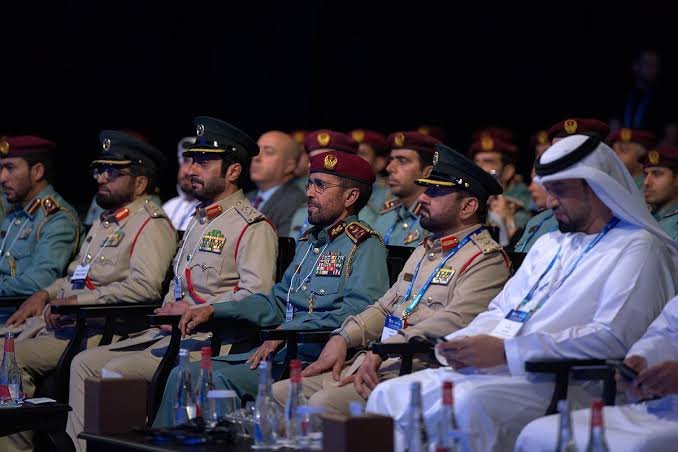
The UAE has removed more than 600,000 websites and online advertisements involved in illegal wildlife trading, officials told the World Police Summit in Dubai on Thursday.
The figure was among the headline announcements on the last day of the three-day event, where police leaders, security specialists and government officials discussed threats ranging from wildlife trafficking to cybercrime, border security and artificial intelligence.
Tougher penalties and a 2030 target
Hiba Obaid Al Shehhi, Assistant Undersecretary for Biodiversity and Marine Life at the Ministry of Climate Change and Environment, said updated laws now provide for up to 15 years in prison and fines of up to Dh2 million for trafficking high-value endangered species.
She said the takedowns were carried out with the Telecommunications and Digital Government Regulatory Authority. The national strategy aims for zero wildlife trafficking by 2030, built on stronger legislation, digital monitoring and international cooperation.
Al Shehhi also directed a message at the public. Owning exotic animals, she said, is not a mark of social status, and she urged families, students and workers to help end the illegal trade.
Why investigations must go further
The panel, titled “Wildlife Crime: Global Action,” also included Siri Blume of the United Nations Office on Drugs and Crime, who leads its Border Management Branch. She argued that cases should not stop once animals or products are seized. In her view, investigations need to continue until those behind the trade are prosecuted. The session was moderated by Lieutenant Hussein Al Marzouqi, a biology expert at Dubai Police.
Other sessions in the border security track covered migration, cross-border intelligence sharing, wildlife detection dogs, airport biosecurity, counter-drone systems and responses to small boats arriving by sea.
A robot on patrol
Technology was never far from the conversation. At its exhibition stand, Dubai Police showed an upgraded version of its DPR2 autonomous robotic patrol. The fully electric, four-wheeled unit uses facial recognition and automatic number plate recognition, as well as behaviour analysis, to spot wanted people, flag vehicles with wanted plates and alert officers to suspected criminal activity.
Lieutenant Engineer Khalid Rashid of Dubai Police’s Artificial Intelligence Department said it combines sensors with visual analysis to widen security coverage, particularly in residential areas.
Government and AI
A conference on assistive artificial intelligence and “zero bureaucracy” in government and security brought together senior officials from the Ministry of Interior and Dubai Police, along with partners including the UAE Cyber Security Council and Mohamed bin Zayed University of Artificial Intelligence.
Major General Khalifa Harib Al Khaili, Undersecretary of the Ministry of Interior, said AI is a strategic tool for improving security operations and services. He stressed that it must be adopted responsibly, with data protection, cybersecurity, transparency, good governance and human oversight of decisions.
Another panel looked at how AI-powered media monitoring could help detect misinformation, and at the governance and ethics of AI agents in government. Dr Mohammed Hamad Al Kuwaiti, Chairman of the UAE Cyber Security Council, spoke about advanced digital threats and information warfare.
Fraud, deepfakes and the human factor
A separate track focused on electronic crime. Discussions covered cyber threat intelligence, payment protection, deepfakes, synthetic identities and cryptocurrency monitoring, with speakers calling for closer cooperation between police and the private sector.
The summit ended on a more human note. Major General Dr Saleh Abdullah Murad of Dubai Police told delegates that any force can buy drones and smart command centres, but trust cannot be bought or imported. He cited research suggesting employees in high-trust organisations report 74 per cent less stress and 50 per cent higher productivity, and he laid out four leadership priorities: building trust, supporting staff wellbeing, strengthening leadership under pressure through diversity, and developing future leaders.
In all, the fifth edition of the summit held more than 55 sessions across four conference tracks.
What to take from it
The wildlife announcement shows how enforcement is shifting online, where much of the trade now happens through websites and adverts. The combination of heavy penalties and large-scale takedowns signals that authorities want to stop the market before animals ever change hands.
For residents, the message is simple. Buying or advertising protected species can carry severe penalties, and the authorities are watching online platforms closely.


Comments 1