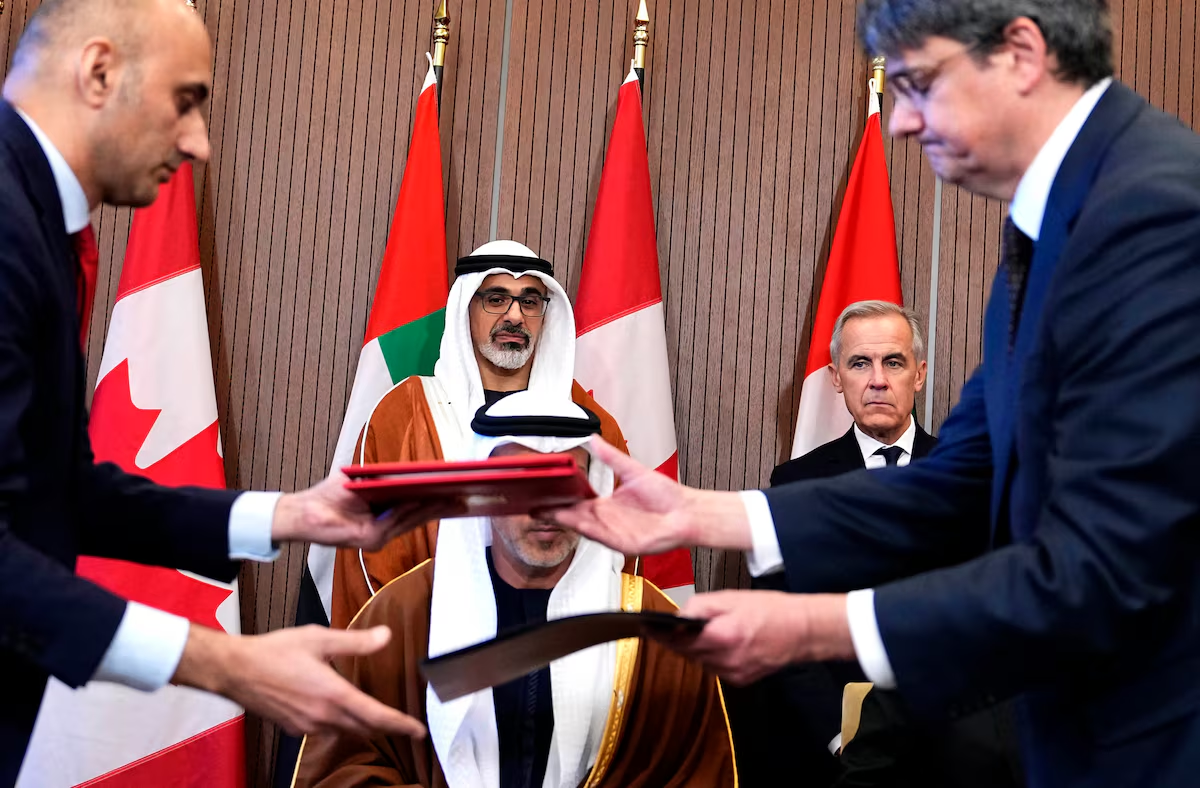
ABU DHABI — The UAE and Canada have moved their relationship into a new phase. A trade agreement has been signed, a defence cooperation pact has been welcomed, and a large investment pledge has been renewed during a two-day visit by Abu Dhabi’s Crown Prince.
Sheikh Khaled bin Mohamed bin Zayed Al Nahyan was welcomed to Ottawa by Prime Minister Mark Carney on the first-ever visit to Canada by a Crown Prince of Abu Dhabi. The joint statement from both governments was published on Wednesday.
A trade deal negotiated at speed
The centrepiece is the Comprehensive Economic Partnership Agreement (CEPA). The leaders noted that negotiations were concluded in just 47 days, on July 24, 2026, and they witnessed the signing of the agreement during the visit.
The partnership already has a base to build on. Bilateral merchandise trade reached approximately CAD 3.5 billion in 2025, which the statement described as significant growth over the previous year. The text also commits both sides to preserving each party’s right to regulate in areas of national importance, including national security, energy and culture. That wording signals that both governments want trade liberalisation without surrendering control of sensitive sectors.
Investment: the CAD 70 billion pledge
Investment remains the headline number. The leaders reaffirmed the Canada-UAE Investment Framework and the UAE’s commitment to facilitate up to CAD 70 billion in strategic investment opportunities in Canada. The commitment dates back to Carney’s visit to the UAE last year. In November 2025, he joined President Sheikh Mohamed bin Zayed to sign a Foreign Investment Promotion and Protection Agreement, launch CEPA negotiations and announce the investment pledge.
The wording matters. The statement speaks of the UAE facilitating opportunities, and the figure should be read as a ceiling on ambition and not as a transfer of funds that has already taken place.
Defence and security
The visit also produced a security dimension. The leaders welcomed a Memorandum of Understanding on Defence Cooperation, which covers joint exercises, cybersecurity, information sharing, digital transformation and professional military exchanges. The memorandum also sets up a Joint Military Committee to support strategic dialogue and military-to-military engagement.
A wide agenda
The talks covered far more than trade. The leaders reviewed trade and investment, defence and security, energy, advanced technology and artificial intelligence, infrastructure, telecommunications, space, food and water security, critical minerals and international cooperation. They also welcomed growing cooperation between Canadian and Emirati development finance institutions, including FinDev Canada and Alterra, and called for innovative ways of mobilising public and private capital for sustainable development.
Why Canada is looking to the Gulf
Canadian reporting framed the deal as part of a wider strategy. CBC reported that Carney is seeking to diversify Canada’s economy away from the United States, and that the agreement covers trade, defence and about $70 billion in investment. Analysts quoted in that coverage tied the push to the ongoing trade war with Washington.
For the UAE, Canada offers energy, minerals, food-security partnerships and access to a developed-market economy. For both, the agreement offers a way to reduce dependence on a small number of larger partners.
Regional diplomacy on the agenda
The meeting also touched on the Gulf’s security situation. Sheikh Khaled and Carney exchanged views on regional and international developments, and stressed the importance of dialogue, diplomatic solutions and coordinated efforts for peace, security and stability. The UAE has repeatedly said it prefers diplomacy to escalation.
What comes next
The CEPA must still pass through each country’s domestic approval processes before it takes effect, and the joint statement does not set a start date. Exporters and investors will be watching for tariff schedules, rules of origin and details on sectors such as food, energy and critical minerals.
For residents and businesses in the UAE, the near-term effect will be gradual. The longer-term test will be whether the pledges become projects, and whether trade grows from CAD 3.5 billion toward the figures both governments have implied.


