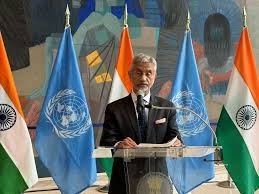
S Jaishankar Criticises Unilateral Sanctions Amid Escalating Middle East Crisis
India’s External Affairs Minister S. Jaishankar strongly raised concerns over the growing use of unilateral sanctions and coercive diplomatic measures during the BRICS Foreign Ministers’ meeting, as tensions in the Middle East continue to impact global trade, energy supplies, and international stability.
Speaking at the high-level BRICS gathering, Jaishankar warned against policies that bypass international law and undermine diplomatic solutions. Without directly naming any country, his remarks were widely viewed as a veiled criticism of the United States and its sanctions-driven foreign policy approach.
The Indian minister emphasized that increasing dependence on sanctions and unilateral pressure tactics cannot replace dialogue and diplomacy. He stated that such measures disproportionately affect developing nations, many of which face severe economic challenges due to disrupted trade routes, rising fuel prices, and geopolitical instability.
The comments came at a time when the Middle East is witnessing heightened tensions and military conflict, particularly around critical maritime routes like the Strait of Hormuz and the Red Sea. These waterways play a major role in global oil and gas transportation, and any disruption directly impacts economies worldwide, including India’s energy security.
Jaishankar highlighted the importance of maintaining safe and uninterrupted maritime trade flows, calling them essential for global economic stability. India has repeatedly expressed concern over attacks on commercial shipping vessels and threats to civilian maritime operations in the region.
The BRICS meeting took place amid growing uncertainty in international relations, with member nations discussing the wider economic and geopolitical impact of ongoing conflicts. The expanded BRICS grouping now includes countries such as Brazil, Russia, India, China, South Africa, Iran, Egypt, Ethiopia, the United Arab Emirates, and Indonesia.
India used the platform to reinforce its long-standing position on multilateral diplomacy and strategic autonomy. Jaishankar stressed that international disputes should be resolved through dialogue rather than coercive pressure. He argued that global institutions and international law must remain central to conflict resolution efforts.
The minister also pointed out that sanctions and trade restrictions often create unintended consequences for developing economies. Rising fuel prices, food shortages, and disruptions in fertilizer supplies have already affected many countries due to ongoing geopolitical tensions. India has repeatedly called for balanced and cooperative approaches to address such global challenges.
Observers believe Jaishankar’s remarks reflect India’s attempt to balance relations between competing global powers while protecting its economic interests. India has maintained diplomatic engagement with both Western nations and BRICS partners despite increasing global polarization. Analysts say New Delhi continues to advocate for a multipolar world order where no single country dominates international decision-making.
The Middle East crisis has become a major concern for India because of its dependence on energy imports and the large number of Indian citizens working in Gulf countries. Any prolonged instability in the region could affect fuel supplies, trade routes, shipping costs, and economic growth.
Recent attacks on commercial ships in the region have further intensified concerns about maritime security. India recently condemned an attack on an Indian-flagged vessel near Oman and reiterated the need to protect civilian shipping and freedom of navigation.
At the BRICS meeting, India also underlined the role of emerging economies in promoting global stability during periods of crisis. Jaishankar stated that BRICS countries could help address issues related to energy, food, health, and economic security through stronger cooperation and dialogue.
The minister’s remarks have drawn international attention as geopolitical tensions continue to reshape global alliances and diplomatic priorities. His statement signals India’s growing focus on protecting economic stability, maintaining strategic independence, and promoting diplomatic engagement in an increasingly divided world.


