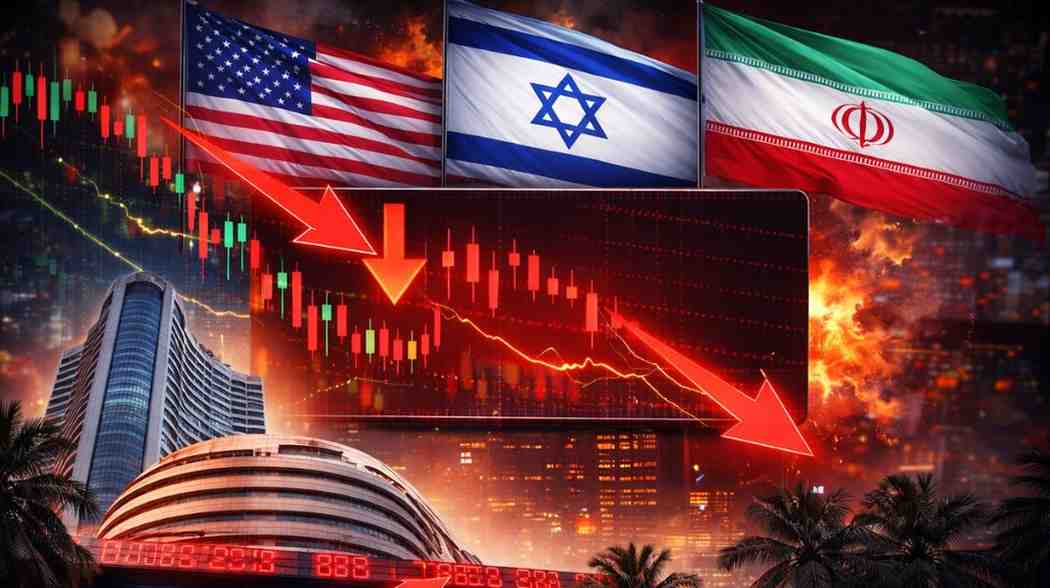
Citi, Nomura Cut Nifty Targets as Iran-US Conflict, Oil Prices Roil Indian Markets
Mumbai, India — The ongoing conflict between the United States and Iran has begun to weigh heavily on global financial markets, with India’s stock market also feeling the impact. Major international brokerage firms have lowered their forecasts for the benchmark Nifty50 index, citing rising geopolitical tensions, surging oil prices and growing uncertainty over global economic growth.
Analysts at global brokerages Citi Research and Nomura have revised their year-end targets for the Nifty50 downward as the conflict in West Asia continues to escalate. According to their updated projections, market volatility is likely to persist due to concerns about energy supply disruptions and the broader economic impact of the war.
Citi has reduced its year-end target for the Nifty50 to 27,000, down from its earlier estimate of 28,500. Despite the revision, the brokerage still believes the index could deliver moderate gains from current levels. The firm also lowered its valuation assumptions, reducing the projected price-to-earnings multiple to 19 times forward earnings, compared with 20 earlier. Analysts say the downgrade reflects rising macroeconomic risks and the possibility that higher crude oil prices could weaken corporate earnings in the coming years.
Nomura has made an even sharper cut to its forecast. The brokerage lowered its target for the Nifty50 to 24,900 for December 2026, compared with its earlier estimate of 29,300. The revision represents roughly a 15 percent reduction in its earlier outlook and suggests more limited upside potential for Indian equities in the near term.
Market experts say the downgrade largely reflects the risks associated with rising oil prices and disruptions to global energy supply chains. The ongoing conflict has created uncertainty around the Strait of Hormuz, one of the world’s most critical oil shipping routes through which about 20 percent of global oil supplies pass. Any disruption in this region tends to push energy prices higher and affects economies that rely heavily on imported crude oil, including India.
The war has already triggered a surge in crude oil prices and heightened fears of supply shocks. Analysts warn that sustained high energy costs could hurt economic growth, push inflation higher and increase fiscal and current account deficits for oil-importing countries.
India’s financial markets have also experienced volatility amid the geopolitical tensions. Investors have become cautious as rising global risks and uncertainty over energy prices have led to selling pressure across several sectors. In recent days, Indian markets have seen sharp declines, with billions of dollars in investor wealth wiped out due to panic selling and capital outflows.
Brokerages have also identified sectors that may be particularly vulnerable if the crisis continues. Industries such as fertilizers and petrochemicals could face pressure due to their dependence on imported energy and raw materials. Auto companies may also be affected by higher fuel costs and potential supply chain disruptions.
Some analysts believe the impact of the West Asia conflict could be more severe than earlier geopolitical crises because of the strategic importance of oil and liquefied natural gas supplies passing through the region. If the conflict intensifies or leads to prolonged disruptions in shipping routes, markets may face additional pressure in the coming months.
Also Read: Formula 1 Drops 2026 Races in Bahrain and Saudi Arabia Due to Conflict
Despite the uncertainty, experts advise investors to remain cautious rather than panic. While geopolitical tensions can cause short-term volatility, long-term market trends often depend on economic fundamentals such as growth, corporate earnings and policy responses. For now, however, the ongoing war has added a new layer of risk for global markets and could continue to influence the outlook for Indian equities in the months ahead.
Citi and Nomura slash Nifty targets as Iran conflict and oil shock rattle Indian markets. Geopolitical risk takes centre stage.


