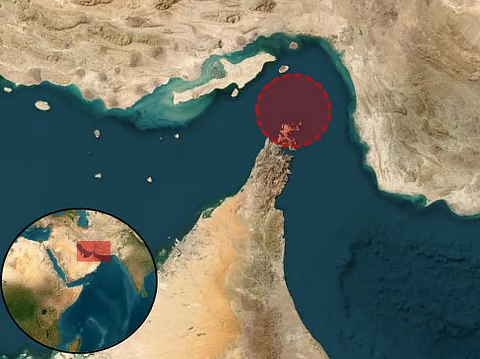
More than eight months after the conflict began, the Strait of Hormuz remains the pressure point on which much of the Gulf’s economic anxiety rests. On Friday, Iran’s Revolutionary Guards signalled the waterway will stay closed until Washington accepts Tehran’s terms. Meanwhile, the United States adjusted its naval posture and Gulf governments pressed for a diplomatic way out.
Tehran Holds Its Line
Hossein Mohebbi, spokesman for the Revolutionary Guards, said Iran will not accept an open-ended stalemate. He said the dispute would be settled either on the battlefield or on Iranian conditions. The strait, he added, will remain shut until the United States meets those conditions in a verifiable way, and Iran will not discuss its nuclear programme until the Hormuz question is resolved.
Separately, Iran’s military claimed that three oil tankers struck naval mines and caught fire east of the strait. That claim could not be independently verified. The Joint Maritime Information Center warned that further attacks on commercial vessels are highly likely.
For the UAE, the danger is concrete. ADNOC Logistics & Services confirmed on Wednesday that one of its vessels was attacked in the strait on Tuesday evening. One crew member is missing and 11 were injured. In August, the company said 15 of its ships had been hit by missiles and drones since the conflict began, with one death and 20 injuries.
Washington Repositions
The USS Theodore Roosevelt carrier strike group arrived in the US Central Command area on Monday. That gives Washington three carrier groups in the region. The USS George Washington has left after about three months and is reportedly heading for its home port in Yokosuka, Japan. US Central Command described the Roosevelt’s arrival as a scheduled deployment, not an escalation. Even so, the timing gives President Donald Trump more room should he decide to resume strikes.
Speaking to Fox News during a visit to China, Trump said Washington would wait and see what happens after 1 January. He did not explain why that date matters. He also played down reports that Iran had explored chemical and biological weapons. Tehran called those reports baseless and denies seeking nuclear weapons.
The financial cost is also becoming a political issue. A senior Pentagon official said the war had cost more than $48.3 billion as of 13 November. That is roughly a quarter above the Congressional Budget Office’s earlier estimate of $38 billion. The figure excludes damage to US bases and wider harm to the global economy. Senator Tammy Duckworth said she would oppose any funding bill that does not cut war spending, which has raised fears of a shutdown in December.
Saudi Arabia Under Fire, Diplomacy Stirs
A Houthi attack on Riyadh damaged the PIF Tower, the kingdom’s tallest building and the headquarters of its sovereign wealth fund. Nearby buildings in the King Abdullah Financial District were also hit. Saudi Civil Defence reported no injuries. The Saudi-led coalition said it had intercepted other missiles aimed at Riyadh and the south. The UAE condemned the attack as a violation of Saudi sovereignty.
On the diplomatic side, Qatar’s foreign ministry spokesman Majed Al Ansari called the Hormuz closure an international crisis that demands collective action. Oman is positioning itself as a mediator. Its foreign minister recently met his Iranian counterpart, Abbas Araghchi, to discuss de-escalation and the safe passage of shipping. No final navigation agreement has been announced. Muscat is not asking the US to abandon its Gulf partnerships. It wants regional governments to lead on their own security arrangements, with Iran expected to show that inclusion brings restraint.
What This Means for Residents
Flights are the most visible effect. Etihad has extended cancellations between Abu Dhabi and both Riyadh and Dammam through 30 November. flydubai has extended its Riyadh and Abha cancellations through 27 November and resumed Dammam on a reduced schedule. The UK Foreign Office describes the regional situation as deeply unpredictable and warns of possible cancellations and airspace closures. The US State Department has also flagged risks to civil aviation in and around the Gulf.
Higher shipping and insurance costs are feeding into fuel prices and supply chains. Authorities advise residents to keep travel documents, emergency contacts and essential supplies ready, and to rely on official channels for updates. Businesses should review their supply chains and insurance cover.
The Outlook
Diplomacy has produced no breakthrough, and the military balance is shifting. The Strait of Hormuz closure remains the central obstacle to any settlement. The Emirates Times will keep tracking developments that affect life in the UAE.


Comments 1