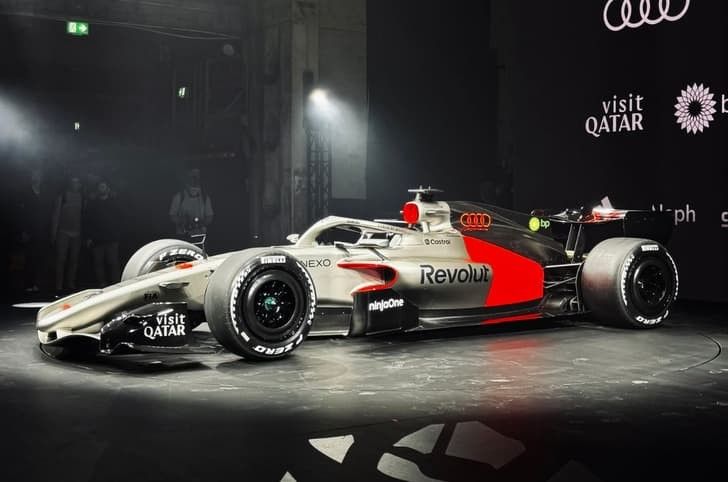
Audi’s Bold Sidepod Concept Debuts at 2026 Bahrain F1 Test
Bahrain International Circuit: Audi has turned heads on the opening day of the 2026 Formula 1 pre-season test in Bahrain, unveiling a radically revised sidepod configuration on its R26 challenger. The Swiss-German outfit, competing as the Audi Revolut F1 Team, has abandoned the conventional design seen during Barcelona shakedowns in favor of an aggressive aerodynamic reinterpretation that stands out among the early-season fleet.
From Conventional to Cutting-Edge
During initial filming days at Barcelona, Audi’s R26 featured relatively traditional sidepods with modest “overbite” inlets and smooth, straight bodywork. In Bahrain, that philosophy has been completely overhauled.
The updated design showcases:
Taller, narrower air intakes positioned more vertically along the chassis flanks.
Flared, ramp-like undercuts directing airflow toward the floor tunnels.
Channelled upper surfaces designed to shorten airflow pathways to the rear diffuser.
Tighter bodywork wrapping around mandated side impact structures.
A small blister near the mirror mount—corresponding to the upper crash structure—completes the distinctive new topography.
Why the Sidepod Redesign Matters
In the ground-effect era of F1, sidepods are no mere cooling ducts. They are critical aerodynamic instruments that shape airflow toward the underfloor—the primary source of downforce under the 2026 technical regulations.
Audi’s aggressive new architecture appears focused on:
Improved airflow control off the front wheels.
Reduced turbulent disturbance entering the underfloor region.
Enhanced aerodynamic efficiency through shortened airflow pathways.
Greater downforce consistency in high-speed corners.
By pushing intakes inward and sculpting exit pathways, Audi engineers aim to minimize the energy loss that compromises downforce stability.
A Departure from Barcelona Spec
What makes Audi’s Bahrain debut particularly striking is the magnitude of change from its Barcelona specification. Shifting from horizontal slats to vertical intakes with aggressively contoured bodywork—mid-development—signals a team willing to rethink fundamental architecture in pursuit of performance.
This flexibility suggests Audi’s engineering team is operating with aggressive development velocity, unafraid to abandon conventional wisdom.
How It Compares to Rivals
Audi isn’t alone in pushing sidepod boundaries. Red Bull and Mercedes have also introduced distinctive aerodynamic interpretations under the new regulations. However, Audi’s solution stands apart for its:
Complexity of surface contours.
Radical departure from its own earlier design.
Unique vertical intake philosophy versus flatter rival layouts.
The 2026 season is shaping up as one of the most aerodynamically diverse in recent F1 memory.
Early Reactions from Bahrain
Paddock observers and technical analysts have converged on Audi’s garage since the R26 rolled out. The sidepods have drawn immediate attention, with rival teams photographing every angle.
While performance data remains preliminary, the visual statement is unmistakable: Audi is not here to follow.
What This Means for the Season
Pre-season testing is notoriously deceptive. Teams run with varying fuel loads, engine modes, and instrumentation. However, bold aerodynamic choices at this stage often signal a team’s development philosophy for the months ahead.
If Audi’s radical sidepods deliver the promised airflow efficiency, the team could emerge as a surprise package in 2026. If not, the Barcelona spec remains a fallback option.
Also Read: Cisco Challenges Nvidia, Broadcom with New G300 AI Networking Chip
Conclusion: A Statement of Intent
The Audi R26’s Bahrain sidepod concept is more than a technical update—it’s a declaration of ambition. In a sport where milliseconds separate glory from obscurity, Audi has chosen the path of innovation over imitation. Whether this bold bet pays off will unfold over the coming days of testing and ultimately the 2026 season. But one thing is certain: the F1 paddock is now watching Audi very closely.


