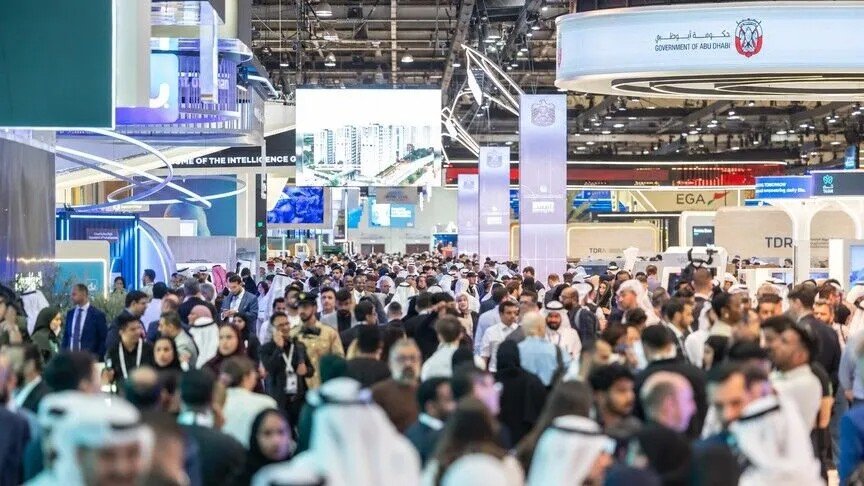
Abu Dhabi will use a two-day technology summit this week to argue that its government is on course to become the first in the world run on artificial intelligence.
The Ai Everything summit opens on Tuesday at the Abu Dhabi National Exhibition Centre (ADNEC). It is hosted by the Department of Government Enablement. Organisers expect thousands of visitors and about 180 speakers.
A government built around AI
The emirate’s pitch is simple. It wants more than 40 government entities to operate inside a single AI-driven ecosystem by 2027.
Wesam Lootah, director general of GovDigital at the department, told the National that Abu Dhabi will reach that goal next year. He described the summit as an invitation for the world to inspect the approach. He said the emirate has built a blueprint and that its effect on public services is already visible.
The numbers behind the claim are sizeable. Officials say more than 100 AI use cases are already live across public services in the emirate. They are backed by a $3.54 billion investment programme meant to speed up AI-led services, economic growth and what officials call responsible deployment.
Ai Everything chief executive Trixie LohMirmand said the real test of AI lies in its effect on science, services and society rather than in hype. She said Abu Dhabi is moving into that territory by assembling infrastructure, research capacity and international partnerships.
Who is on the stage
Among the headline speakers are Arthur Mensch, co-founder and chief executive of the French generative-AI company Mistral AI, and Marc Raibert, founder of Boston Dynamics, the robotics firm. Between them, the two cover much of the current debate. One focuses on language models and the other on machines that move in the physical world.
Organisers say the programme will include live demonstrations from public services, banking, health care, energy and education. The aim is to show working systems rather than forecasts. Companies and governments are under growing pressure to show returns on heavy AI spending, and the summit is partly pitched as a place to test that.
Jobs and pay
The jobs question will feature prominently. LinkedIn analysis cited ahead of the event shows AI-related job postings have doubled since 2023. A typical AI posting offers about $177,000 a year, compared with about $80,000 for a non-AI role. AI engineers have overtaken machine learning engineers as the most common AI job title on the platform.
The same analysis points to roles that new technology may make redundant. Speakers are expected to address both sides, covering the jobs being created and those that may disappear.
The gender gap
Organisers also plan to put inequality in the sector on the agenda. Women made up only 25 per cent of AI hires in the United States in 2025, against 50 per cent in non-AI occupations. Across 27 countries, women hold just 13 per cent of top leadership roles at AI companies.
The figures were highlighted by the gap at a recent White House AI gathering, where only two of the 31 business leaders and guests were women.
Safety and control
The summit arrives while governments and companies are searching for ways to keep a fast-moving technology under control. Investment in AI was heavy throughout 2026, and safety concerns have dominated discussion in recent months. Sessions on AI safety are among the most anticipated.
For the UAE, the event reinforces a strategy of positioning itself as a regional hub for AI development and application. The test will be whether the demonstrations on show this week match the scale of the promises.


