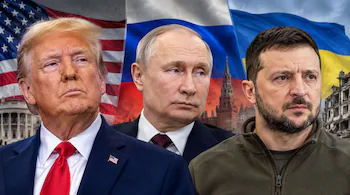
ABU DHABI: The UAE capital has once again become a venue for negotiations over the war in Ukraine, as delegations from Moscow, Kyiv and Washington opened two days of talks on Tuesday.
The three-way session is the first meeting of its kind since February and comes as Washington renews its push to end a conflict that began with Russia’s full-scale invasion nearly five years ago. The head of Kyiv’s delegation confirmed the talks had opened, while Russian state media reported that the Russian delegation had arrived at the venue
What is on the agenda
Security guarantees are expected to take centre stage. Officials said the discussions would also cover de-escalation, humanitarian measures and the prospects for a wider settlement. The White House said before the talks that guarantees would be the focus.
A US official described the thinking in some detail on Monday. The aim, the official said, is to address guarantees first and then the longer-term security architecture between Russia and Europe, including how to reduce the risk of future conflicts.
Ukraine’s president has outlined his own priorities. Volodymyr Zelenskyy has said the agenda includes security guarantees, a possible halt to strikes on energy infrastructure and the reopening of the Black Sea for grain exports.
Who is at the table
Rustem Umerov, secretary of Ukraine’s National Security and Defence Council, took part alongside Kyrylo Budanov, the president’s chief of staff, and David Arakhamia, who leads the parliamentary majority faction. Vladimir Medinsky, who heads the Russian delegation, remarked at the start that his team had become bigger and more professional.
The US side is led in the room by Jared Kushner. American officials were due to meet representatives from Ukraine, the EU, NATO, Germany, France, Britain and Italy before the trilateral session. Kushner said on X that a lasting settlement will also need direct engagement between Russia and European partners, and that Abu Dhabi will set the stage for that process.
Positions remain far apart
Few observers expect an early breakthrough. Russia is demanding major territorial concessions, while Ukraine says it will not give up any territory and wants strong protection against future aggression. Zelenskyy has also rejected limits on Ukraine’s military or on its arrangements with Western partners, which Kyiv regards as essential to deterring another invasion.
Moscow has welcomed the focus on collective security. Foreign Minister Sergey Lavrov said Russia was glad the US negotiators, at President Donald Trump’s request, proposed putting the issue at the top of the agenda. Russia has long described NATO as a threat, while Ukraine’s concern is preventing a repeat of the invasion.
The UAE’s role as host
The Emirates is not new to this process. Two earlier rounds were held in Abu Dhabi in January and February, followed by a meeting in Geneva. The two countries have also exchanged hundreds of prisoners since the war began following UAE mediation.
That track record helps explain why the venue keeps returning. The UAE keeps working relationships with all three parties and has positioned itself as a discreet facilitator rather than a participant. In late October, the Kremlin said talks were planned for November in the Emirates, after earlier meetings lapsed while the Trump administration was focused on its war with Iran.
The wider backdrop
The talks open against a tense military and political background. Ukraine said it shot down 135 Russian drones ahead of the Abu Dhabi meeting. Meanwhile, the Kremlin voiced hope that Trump would continue his peace efforts despite his party’s midterm election losses
The Iran conflict also hangs over the diplomacy. Washington’s attention has been divided, and the same week sees separate US-brokered efforts on the Gulf. How much political capital the administration can devote to Ukraine remains an open question.
What to watch
The session continues on Wednesday. Key signals will be whether the parties agree on any partial steps, such as a pause in strikes on energy facilities or arrangements for Black Sea grain exports, and whether European governments are drawn directly into the process, as Kushner has suggested.
For the UAE, hosting another round reinforces its standing as a venue where hard conversations can take place. For Ukraine and Russia, the more difficult task is bridging gaps that earlier rounds in Abu Dhabi, Istanbul and Geneva did not close.


Comments 1