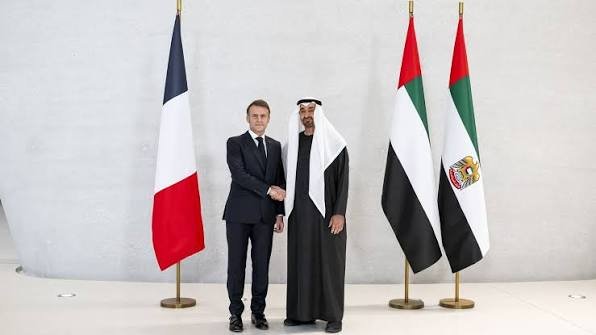
The United Arab Emirates and France have deepened their military relationship with the formal exchange of a strategic defence framework. The step came as President Emmanuel Macron ended the Emirati leg of a Gulf tour that also produced fresh diesel commitments for a French economy under strain.
Sheikh Mohamed bin Zayed Al Nahyan and Macron witnessed the exchange on Tuesday, a day after the French leader’s regional tour began in Kuwait.
A new framework for defence cooperation
The Strategic Defence Partnership Framework was exchanged by Mohamed bin Mubarak Al Mazrouei, the UAE’s Minister of State for Defence Affairs, and Catherine Vautrin, France’s Minister of the Armed Forces and Veterans Affairs. The two presidents also watched the exchange of an agreement setting out implementing arrangements for the defence industry.
Earlier in the day, the two leaders toured advanced manufacturing sites at Tawazun Industrial Park, which hosts companies run by the UAE’s largest defence group. Sheikh Mohamed later saw Macron off as he left for the next stop on his tour.
The announcements so far describe the documents in general terms and do not set out their contents. Both governments have, however, framed the visit as an effort to strengthen coordination on regional security and stability.
Diesel for a country under pressure
The visit also had an urgent economic purpose. The French presidency said Macron had secured an additional 200,000 tonnes of diesel a month from the UAE and Bahrain, as his government scrambles to contain a cost-of-living crisis that has fuelled unrest at home.
The UAE and Bahrain will each supply 100,000 tonnes a month, roughly 746,000 barrels, for an unspecified period. Saudi Arabia will provide 95,000 tonnes a month in October and November. Together with the Saudi deliveries, France now has commitments for 295,000 tonnes a month, just over 10 per cent of its consumption.
That is a meaningful cushion rather than a cure. Surging diesel prices have contributed to violent scenes in Paris in recent days, and the extra Gulf cargoes will only partly offset the pressure on pump prices.
Decades of defence ties, and some friction
The defence relationship rests on a long record. The two countries’ military cooperation is anchored by a mutual defence pact signed in 1995. In 2021 the UAE ordered 80 Rafale fighter jets, a deal valued at €16.6 billion, with the first aircraft inaugurated in January 2025.
The partnership has also been tested in practice. In early March, France said it had deployed Rafale fighter jets over the UAE to protect French naval and air bases from Iranian attacks. Later that month, Vautrin visited Abu Dhabi and repeated France’s condemnation of Iranian attacks on the UAE and other regional states.
Not every project has run smoothly. French press reports in the spring said the UAE had pulled out of a proposal to co-fund development of the next-generation Rafale F5, leaving the French Defence Ministry to carry the cost. The new framework suggests both capitals are keen to keep the broader relationship on track regardless.
Why the timing matters
Analysts see a mutual logic at work. Macron is pursuing energy supplies and defence exports at a time of major disruption to global fuel shipments linked to the war on Iran, and while France carries record national debt. The Gulf states, for their part, want dependable security partners and diversified suppliers.
For the UAE, a formal framework with a permanent member of the UN Security Council, backed by industrial cooperation, adds depth to a relationship that already includes major arms purchases and a French military presence in the country. For France, the diesel pledges offer short-term relief, and the defence agreements point to longer-term commercial and strategic returns.
Much now depends on how the framework is implemented, including its funding, its industrial elements and the length of the diesel commitments, which officials have not yet specified.


Comments 1