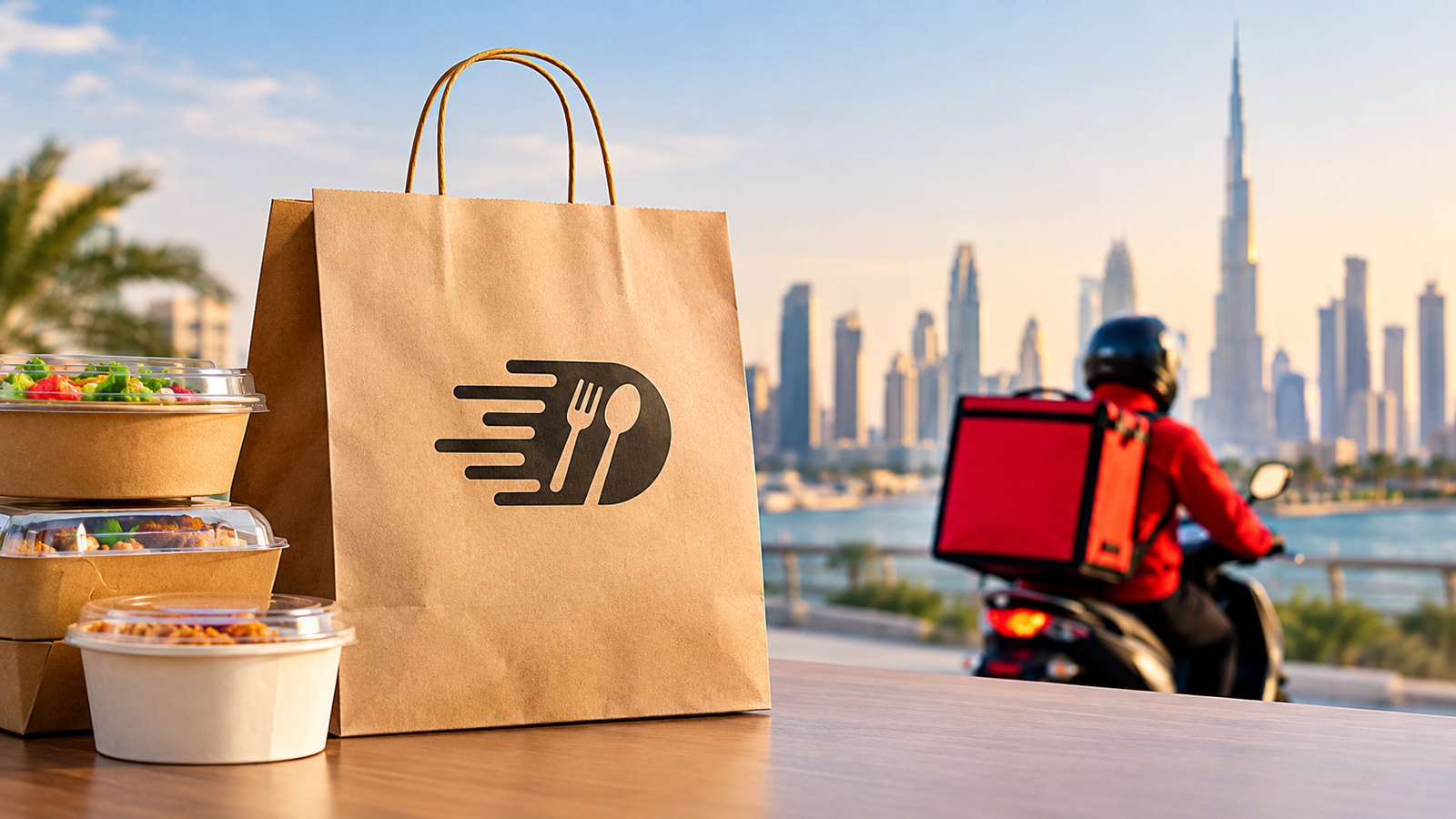
- For years, the takeaway bag was an afterthought in restaurant planning. It was ordered once, reordered when stock ran low, and rarely discussed at management level. That is changing in the UAE, and the reason is in the numbers.
According to Syrve MENA, which tracks orders across restaurants using its management software, UAE delivery orders grew by 15.2% year-on-year in the first half of 2026. Delivery now accounts for 30.5% of all restaurant orders in its network, up from 25.4% a year earlier. Over the same period, dine-in orders fell by 10.5%.
In other words, almost one order in three never sees the dining room. For those customers, the restaurant’s interior, service and plating are replaced by a single object: the bag that arrives at the door.
The bag has become the dining room
A guest who eats in judges a restaurant on dozens of details. A delivery customer judges it on far fewer, and the packaging is the first of them. Before the food is tasted, the customer has already seen whether the bag arrived upright, dry and intact, or crushed, stained and open at the seam.
This matters more in the UAE than in many markets. Delivery apps put dozens of similar restaurants side by side, and repeat orders depend on a good first experience. When the product is similar, the unboxing becomes part of the reason to reorder.
What “delivery-first” means for packaging
Restaurants that treat delivery as a core channel, rather than an add-on, tend to rethink the bag around four practical questions.
1. Does the bag fit the containers?
Most delivery complaints about packaging are not about the bag failing outright. They are about food shifting inside it. A bag that is too wide lets containers tilt; one that is too narrow forces the courier to stack boxes at an angle. The fix is simple but rarely done: measure the standard container combinations for single, double and family orders, and choose bag sizes around them. Paper bags with a rectangular, flat bottom keep containers level, which is why they have become the default for food delivery.
2. Is it strong enough for the heaviest order, not the average one?
Delivery orders are heavier than takeaway coffee and pastries. Drinks, sauces and family meals add up quickly. As a rough guide, bakery bags are often made from 70–80 gsm paper, while bags for delivery and heavier retail use typically start at 90–110 gsm, and loads with bottles or multiple drinks call for 120 gsm. Twisted paper handles, properly glued, can carry around 5–10 kg depending on the paper and construction. The right choice is the one that survives the busiest Friday night, not the quiet Tuesday lunch.
3. Can it cope with heat and steam?
Hot food produces steam, and steam weakens paper. In the UAE, a bag may also spend time in a hot vehicle or at a building entrance in summer. For hot dishes, restaurants increasingly use foil-lined thermal bags, which hold temperature and resist moisture, while keeping standard kraft bags for cold or dry items. Separating hot and cold items into different bags also helps both arrive as intended.
4. Does the brand survive the journey?
A delivery bag passes through several hands: kitchen staff, the courier, a building concierge, sometimes a colleague at the reception desk. Each of them sees the logo. A clear, well-printed brand mark turns every order into a small piece of outdoor advertising in offices, residential towers and lobbies across the city. Print that stays sharp after handling is part of the investment, not decoration.
Fewer outlets, more orders per outlet
The same Syrve data points to another shift. In the first quarter of 2026, the number of restaurants offering delivery in its UAE network fell slightly, while the average delivery venue processed 64 orders a day, compared with 54 a year earlier. Delivery is concentrating in operators that do it at scale.
For those operators, packaging stops being a small purchase and becomes a supply chain item. Running out of the right bag size during a peak weekend means improvising with the wrong one, and that shows up in reviews. Busy kitchens benefit from a short, fixed range of bag sizes, consistent specifications from batch to batch, and a reorder point set before stock gets low.
Margin pressure makes the bag work harder
Delivery has a cost problem. Industry reporting on the Syrve figures notes that a delivery order brings in noticeably less at the till than a dine-in order, before platform commissions. That pushes restaurants to look for savings, and packaging is an easy target.
Cutting the wrong corner, however, rarely saves money. A torn bag or a spilled sauce often leads to a refund, a replacement or a low rating, each of which costs more than the difference between a thin bag and a suitable one. The more sustainable saving comes from standardisation: fewer sizes, bought in planned volumes, with a specification that matches the real load.
A short checklist for delivery-first restaurants
- Size by container, not by guess. Map your common order combinations and pick two or three bag sizes that fit them.
- Specify for the peak load. Choose paper weight and handles for your heaviest typical order.
- Separate hot and cold. Use thermal bags for hot dishes and standard kraft for drinks, desserts and dry items.
- Keep the brand visible. Place the logo where it is seen when the bag is carried, not only when it is opened.
- Plan stock around peaks. Weekends, Ramadan evenings and the festive season all bring delivery spikes.
The bottom line
When nearly a third of restaurant orders are delivered, the takeaway bag is no longer a consumable. It is the only part of the restaurant many customers physically touch. Manufacturers such as Vita Group, which produces paper bags for restaurants, retail chains and delivery services, see the same pattern in requests from food businesses: the questions are shifting from “what is the cheapest bag” to “which bag gets the order to the customer the way the kitchen intended”.
For UAE restaurants competing on delivery apps, that is the right question to ask.


