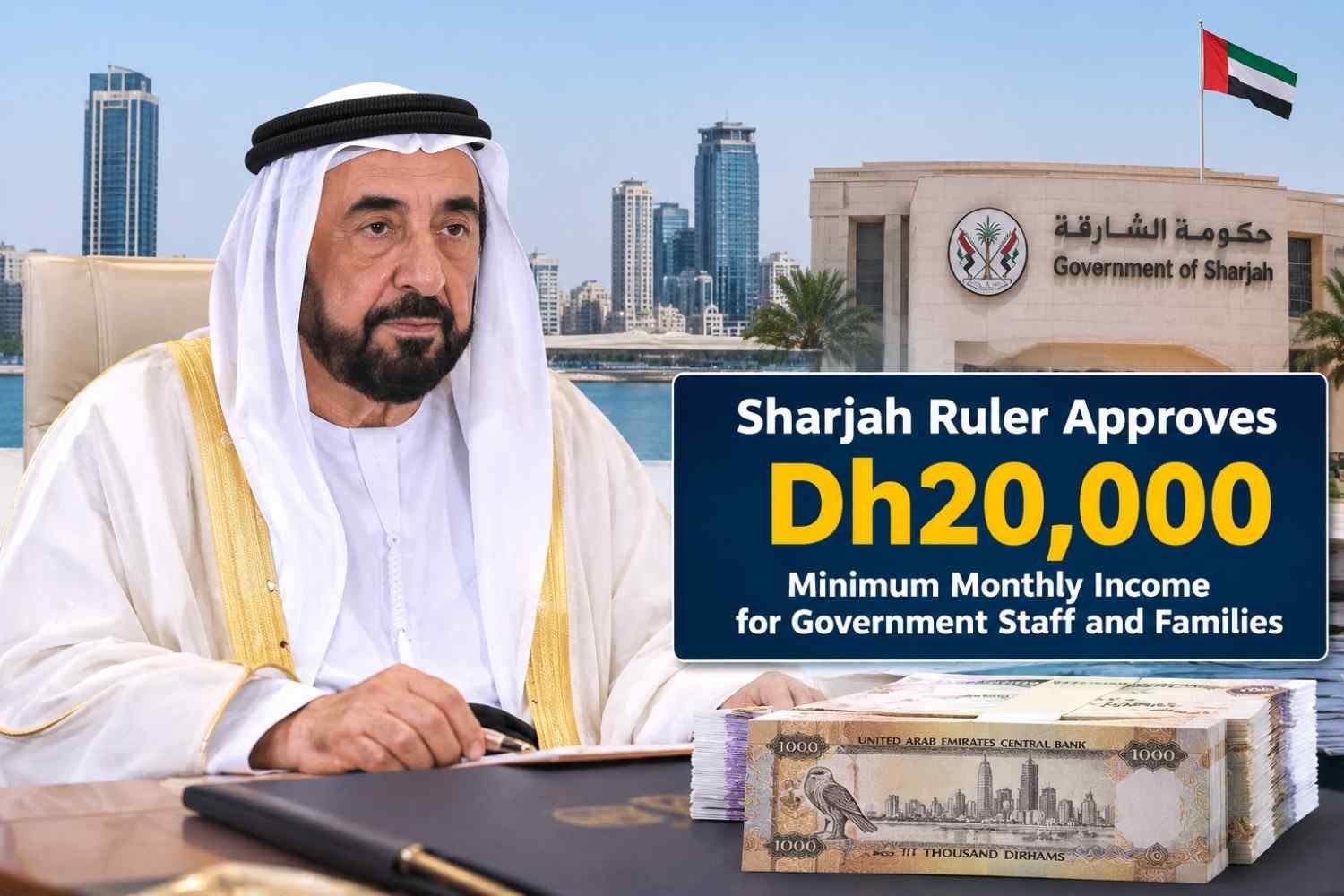
Sharjah Raises Income Floor to Dh20,000 in Major Welfare Boost
Sharjah has taken a significant step to ease the financial pressures facing thousands of families, after His Highness Sheikh Dr Sultan bin Muhammad Al Qasimi, Member of the UAE Supreme Council and Ruler of Sharjah, approved a new minimum monthly living allowance of Dh20,000 for government employees, retirees and households receiving social assistance across the emirate.
A Package Years in the Making
The decision, which took effect this September, follows what officials describe as extensive research into the real monthly needs of Emirati families living in Sharjah. Rather than a blanket salary increase, the measure functions as an income floor, meaning anyone falling under the covered categories whose current earnings sit below Dh20,000 a month will now see their income topped up to meet that threshold.
Abdullah Ibrahim Al Zaabi, director of Human Resources in Sharjah, explained that the new order reflects Sheikh Sultan’s long-standing commitment to ensuring a dignified standard of living for citizens, particularly as the cost of housing, education, healthcare and daily essentials continues to climb across the UAE. The initiative is one of several social and economic reforms Sharjah has introduced in recent years aimed at strengthening support structures for citizens and their families.
Who Benefits
The scale of the package is considerable. According to figures released alongside the announcement, the new Dh20,000 floor will directly benefit 17,776 government employees working across Sharjah’s public sector. In addition, more than 6,650 families currently receiving social assistance from the Sharjah government will see their monthly support raised to the same minimum level, addressing what officials estimate to be more than 6 million dirhams a year, cost-wise, on that segment alone.
Retirees have not been left out either. Some 2,251 individuals who retired from Sharjah government roles will now receive the Dh20,000 minimum, while a further 5,300 retirees who spent their careers outside Sharjah’s government but reside in the emirate will also benefit from the new baseline.
Taken together, officials estimate the annual cost of the full package at well over Dh1.1 billion, underlining the scale of the emirate’s financial commitment to the initiative. The government workforce alone accounts for the largest share of that spending, at more than Dh720 million a year, while the social assistance and retiree components add several hundred million dirhams more.
Why It Matters for Sharjah’s Economy
Economists and social policy observers say the move reflects a broader trend across the UAE, where individual emirates are increasingly tailoring welfare and public-sector compensation policies to reflect local economic realities rather than applying uniform, federal-level frameworks. Sharjah, the UAE’s third-largest emirate by population, has a notably high concentration of Emirati families compared with more expatriate-heavy Dubai and Abu Dhabi, making targeted income support measures particularly consequential for the local population.
By lifting the income floor for its own workforce, Sharjah is also positioning itself competitively against other emirates when it comes to attracting and retaining Emirati talent in government roles, a priority policymakers across the UAE have emphasised as part of broader Emiratisation efforts in recent years.
A Broader Pattern of Support
This latest measure builds on a series of social initiatives Sheikh Sultan has introduced over recent years, ranging from housing support programmes to education-related relief packages for vulnerable groups. Officials in Sharjah have consistently framed these interventions as part of a long-term strategy to strengthen family stability and reduce financial strain on citizens, rather than one-off adjustments tied to short-term economic conditions.
For the thousands of families now covered under the new Dh20,000 threshold, the change is expected to translate into more breathing room for essentials such as rent, school fees and healthcare, particularly for larger households where a single income has to stretch across many dependents.
What Comes Next
Government departments in Sharjah are expected to begin implementing the adjusted pay and allowance structures through payroll and benefit systems already in place, with officials indicating the changes are designed to take effect smoothly without requiring additional applications from most eligible employees and retirees. Families currently receiving social assistance are advised to confirm their status through the relevant Sharjah government department to ensure their support is adjusted accordingly.
The Emirates Times will continue to follow how this policy shapes household budgets and public-sector employment trends across Sharjah in the months ahead. Next Article


Comments 1