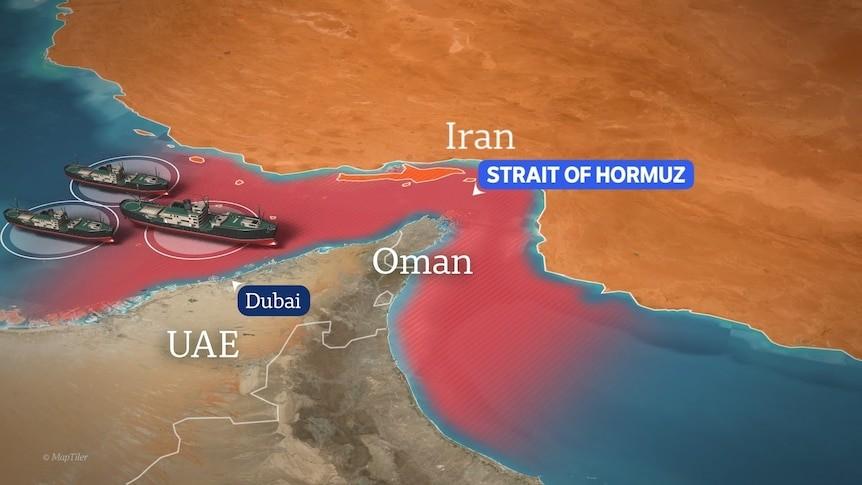
Strait of Hormuz Threat: How Cheap Naval Mines Could Cripple Global Oil Shipping
Dubai/Tehran — Rising tensions in the Middle East have once again drawn global attention to the strategic waters of the Strait of Hormuz, where naval mines are considered one of the most dangerous yet inexpensive weapons that could disrupt maritime traffic. Security experts warn that if such mines are deployed in the narrow sea passage, they could threaten ships and severely impact global oil supplies.
The Strait of Hormuz is one of the world’s most crucial maritime routes, linking the Persian Gulf with the Arabian Sea. Roughly one-fifth of the world’s oil supply passes through this narrow channel, making it vital for global energy markets. Any disruption in the strait can quickly affect oil prices and international trade.
In recent years, geopolitical tensions involving Iran, the United States, and other regional powers have raised fears that naval mines could be used to block or threaten shipping lanes. Military analysts say such weapons are particularly effective in confined waterways like Hormuz because ships must travel through limited channels, making them vulnerable targets.
Naval mines are underwater explosive devices designed to damage or sink ships. Despite their destructive potential, they are relatively inexpensive compared to modern military weapons. A basic contact mine can cost as little as around $1,500, making it an attractive option for countries seeking cost-effective ways to challenge stronger naval forces.
Because of their low cost and high impact, mines are often used in “asymmetric warfare,” where a weaker military force tries to offset the technological superiority of a stronger opponent. A single mine costing only a few thousand dollars can disable a vessel worth hundreds of millions.
There are several types of naval mines, each designed to attack ships in different ways.
Contact mines are the simplest type. These are typically anchored below the water’s surface and explode when a ship physically collides with them. They are often recognizable by their spherical shape with protruding spikes.
Influence mines are more advanced. Instead of requiring direct contact, they detect changes caused by a nearby ship—such as magnetic fields, sound, or water pressure—and detonate automatically. These mines are harder to detect and avoid.
Another type is the rising mine, which launches upward toward a target once triggered. This allows the explosive to strike a ship’s hull more effectively, increasing the damage potential.
Naval mines can be deployed in several ways. They may be dropped from ships, submarines, or aircraft, and in some cases even placed by small boats. Once deployed, they can remain underwater for long periods until triggered by a passing vessel.
Because mines can be laid quickly and secretly, they are difficult for navies to counter immediately. Even the suspicion that mines may be present can force ships to avoid an area, effectively disrupting shipping without a single explosion.
In busy shipping lanes like the Strait of Hormuz, the use of naval mines could halt maritime traffic and cause significant economic damage. Oil tankers and cargo ships depend heavily on this route, and even a small number of mines could force vessels to reroute or delay their journeys.
Clearing naval mines is also a slow and complex process. Specialized minesweeping ships and underwater drones are required to detect and safely remove them, meaning that a mined waterway can remain dangerous for days or even weeks.
Because of their low cost, ease of deployment, and ability to disrupt vital shipping routes, naval mines remain a powerful strategic tool in modern naval warfare. In a sensitive region like the Strait of Hormuz—where geopolitical tensions often run high—the threat of these underwater weapons continues to be a serious concern for global security and energy markets.
Also Read: Adobe Photoshop Introduces AI Assistant With Natural Language Editing Commands
For this reason, international navies closely monitor the area and maintain mine-countermeasure capabilities to ensure that one of the world’s most important maritime routes remains open and secure.
$1,500 weapons that could choke 20% of the world’s oil: The Strait of Hormuz naval mine threat explained.


