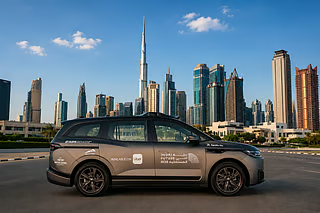
Dubai’s push to put self-driving cars into everyday traffic has taken a bigger step. Uber announced at Dubai Future Week that it will invest Dh184 million, roughly $50 million, over the next two years to expand its autonomous ride service into some of the emirate’s busiest commercial districts.
What Uber Has Announced
The company said it will extend robotaxi rides to Downtown Dubai, the Dubai International Financial Centre and Business Bay. It announced the plan on Wednesday, 18 November, and Sheikh Hamdan bin Mohammed bin Rashid Al Maktoum, Crown Prince of Dubai, was briefed on it.
Riders in the new districts will begin with a vehicle specialist on board to monitor operations. Fully driverless commercial rides are planned for the following months, subject to operational readiness and regulatory approvals. The investment will also cover operational infrastructure and stronger partnerships with companies that build autonomous driving technology.
In Jumeirah and Umm Suqeim, where the service already runs, the next phase will let riders book door-to-door trips through the Uber app. They will no longer need fixed pick-up and drop-off points. One example given was a journey between Kite Beach and Madinat Jumeirah.
How Dubai Got Here
The expansion builds on a rollout that has moved quickly this year. Dubai’s Roads and Transport Authority (RTA) announced commercial driverless operations in Umm Suqeim and Jumeirah at the end of March, starting with about 100 vehicles. Uber and the Chinese company WeRide began charging fares for fully driverless rides on routes in the same area around the end of that month. In August, Uber began matching riders with Baidu’s Apollo Go vehicles on its platform.
The RTA has also worked with Pony.ai. Dubai Taxi Company offers Apollo Go rides on its own app, free during an initial phase. It has said fares are expected to match regular taxis once the promotion ends.
The authority reported more than four million kilometres and 7,613 passenger trips as of mid-August, with a customer satisfaction rate of 97 per cent. Those numbers are still small for a city of Dubai’s size, but they show the service has moved beyond a demonstration.
Why Business Districts Matter
Downtown, DIFC and Business Bay are different from the villa-lined streets of Jumeirah. Traffic is denser, junctions are more complex and pedestrian numbers are higher. Putting a specialist in the car at the start is a cautious way to test the technology in tougher conditions before removing the human supervisor.
For commuters, the potential benefit is clear. These districts are packed with offices, hotels and restaurants, and they have some of the city’s most congested roads. A fleet that can operate around the clock without the usual constraints on driver hours could change how people get to meetings and lunch. Whether it can do so safely at scale is the question regulators will ask.
The 2030 Target
Mattar Al Tayer, the RTA’s director general, described the investment as a shift from pilot projects and limited operations towards wider deployment of integrated commercial services. He said it will support the Dubai Autonomous Transportation Strategy, which aims for 25 per cent of all trips in the emirate to be autonomous by 2030.
That is an ambitious goal. Reaching it will need many more vehicles, a dense network of charging and maintenance depots, and public trust. It will also depend on clear rules covering liability, data and passenger safety.
What Remains Uncertain
Several details have not been made public. Uber has not said how many vehicles will serve the new districts, how fares will compare with conventional taxis, or exactly when fully driverless operation will begin. The phrase used was “the following months,” and the start date depends on approvals still to come.
There is also the wider operating environment. The region has faced security-related disruption this year, and the IMF has said it expects tourism and trade to recover in 2027. A confident investment announcement of this size suggests companies still see Dubai as a strong market for new mobility technology.
For now, residents in Jumeirah and Umm Suqeim can already book driverless rides. Those who work in the city’s business core will have to wait, but not for long, if the plan holds. The Dubai robotaxi story is moving from the beachfront to the financial centre.


Comments 1