Millions of UAE drivers, riders and vehicle owners will face a different set of rules from the first day of next year. The changes come from Cabinet Decision No. 174 of 2026, issued in October, which sets out the executive regulations of the 2024 federal traffic law. They take effect on January 1, 2027.
Five vehicles, with a catch
The headline change is a limit on how many vehicles one person can register. The cap is five. Under Article 89, residents may register up to two vehicles in the ordinary way, while a third, fourth or fifth vehicle attracts an additional fee. Important details are missing. The regulation does not state how large the extra fee will be, or how the limit will apply to people who already hold more than five vehicles. Authorities will likely need to clarify both points before enforcement begins.
Standard fees appear unchanged for now. The National reported that registering a new vehicle costs Dh400, while renewal costs Dh350 plus Dh150 for inspection.
Two-year registration for newer cars
Vehicle licences will generally remain valid for one year. Owners of new cars may request a two-year registration instead. To qualify, the car must have been new when first registered and be no more than six years from its manufacturing date. For families and fleet operators, fewer annual renewals could save time and paperwork.
Two other rules are worth noting. Right-hand-drive vehicles will be licensed only for display purposes, and vehicles that fail the prescribed road-safety requirements will not be eligible for a licence.
E-scooters: permits, registration and equipment
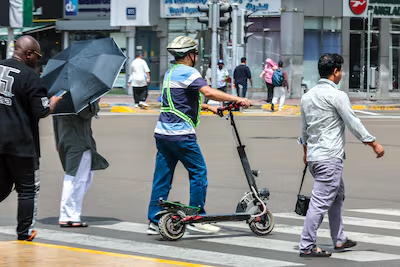
The rules for electric scooters and similar personal mobility devices are the most significant for everyday road users. They also cover e-bikes and mopeds. Riders must apply for a permit and be at least 15 years old. Permits will be valid for three years, and devices must be registered with the licensing authority in each emirate.
The 15-year minimum applies to permit applicants. Dubai’s existing rules, however, bar anyone under 16 from riding an e-scooter, and the new regulations do not explain how the two will fit together. Residents of Dubai should therefore keep following the local rule until the authorities say otherwise.
The regulations also set technical and behavioural standards:
- Scooters must have front headlights, rear lights, brake lights and an audible warning device, plus brakes on at least the rear wheel.
- Riders must stay on designated routes and keep off roads reserved for motor vehicles.
- Riders must obey speed limits. A moped, for example, may not exceed 45 km/h.
- Crossing at a red signal is prohibited, and crossings on green must follow the rules.
What experts say
Mustafa Aldah, a traffic safety expert, told The National the changes are a significant step forward. He said they bring the rules in line with how people move today, including e-scooters, delivery riders, car rentals and newer vehicle technology. He stressed that public awareness is now the priority so that drivers, riders and employers understand the changes before enforcement starts.
Others are more cautious. Road safety advocate Thomas Edelmann said lowering the permit age to 15 would achieve little without stronger enforcement of existing rules. He said he regularly sees young children riding scooters, sometimes in pairs, performing stunts, using pedestrian walkways or riding against traffic. In his view, responsibility should extend beyond police to parents and schools, and adults should set an example by wearing helmets and following the rules.
The debate comes after a year of heightened attention to scooter safety. The National has reported that Abu Dhabi Police confiscated more than 9,230 e-scooters in the past ten months, and Dubai Police have said they will hold parents accountable for children’s unsafe scooter use.
What to do now
The rules do not take effect for another two months, which leaves time to prepare:
- Vehicle owners: Count the vehicles registered in your name and watch for the fee schedule.
- New-car buyers: Ask about the two-year registration option.
- Riders and parents: Check whether your device meets the equipment standards, and expect to apply for a permit and register it.
- Employers with delivery riders: Review permits, equipment and routes before the deadline.
Further guidance from the Ministry of Interior and local traffic authorities is likely in the weeks ahead. Until then, the clearest message is that micromobility in the UAE is moving from a loosely managed convenience to a regulated form of road use.


Comments 1