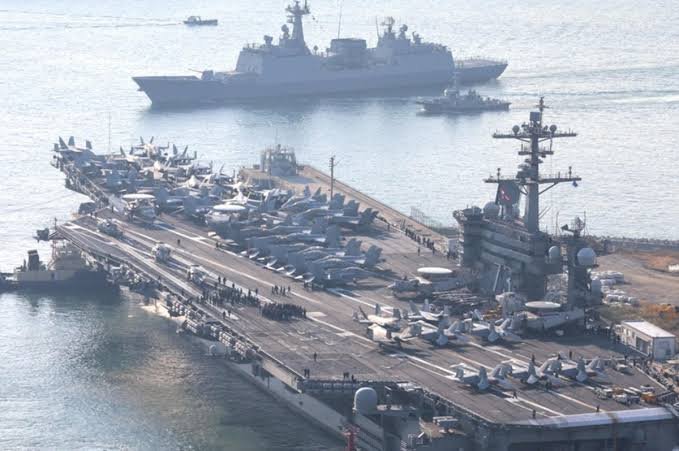
The military build-up around the Gulf has grown again, even as diplomats try to keep a deal alive. For UAE residents, Thursday brings a familiar mix of reassurance about flights at home and uncertainty about the region.
More US forces on the way
A third US aircraft carrier and additional troops are moving toward the Middle East. No peace agreement has been announced. US officials told regional allies on Thursday to prepare for possible strikes on Iran after the November 3 midterm elections, and for Iranian retaliation. Two diplomats stressed that President Donald Trump has not made a final decision.
That distinction matters. CNN reported earlier this week that US forces were ready to start major operations within 96 hours of an order. Readiness is not authorisation, and no order has been reported.
Diplomacy with conflicting accounts
Talks continue, but the signals are mixed. Iranian Foreign Minister Abbas Araghchi said Tehran remained in contact with mediators over a seven-day plan to end the war and reopen Hormuz, possibly faster than a week. A senior Iranian official told Reuters, however, that Qatar had offered unacceptable ideas rather than a real offer, which contradicts another account of a draft agreement.
Saudi, Pakistani, Turkish and Iranian officials agreed on Monday to keep talking, but disputes over nuclear negotiations, sanctions, shipping and regional security remain open.
Hormuz: competing claims
Shipping safety is also contested. US Central Command rejected the Islamic Revolutionary Guard Corps’ account of commercial ships hitting mines. It said internationally recognised main transit lanes are cleared and that thousands of vessels have passed safely. The statement does not mean every part of the Gulf is free of mines or that traffic has returned to normal.
Saudi Arabia and Yemen
Saudi-led coalition spokesman Turki Al-Malki said air defences intercepted and destroyed a Houthi ballistic missile launched toward the Eastern Province early on Thursday. Separately, Yemeni officials said missile attacks on Aden airport on Wednesday caused civilian injuries and damage, and halted air traffic. BBC reported that the escalating attacks have led the US to order the departure of non-essential embassy staff in Saudi Arabia.
Flights: what has changed
For travellers, the news is better but uneven. Etihad’s advisory confirms that flights from Abu Dhabi to Riyadh and Dammam are cancelled through November 5, along with four Jeddah services. The airline said further changes remain possible.
Other carriers are moving the other way. Emirates has listed resumptions to Jeddah on October 30, and to Riyadh and Dammam on November 8. flydubai lists resumptions to Riyadh, Dammam and Abha from October 30. Air India and Air India Express services to Riyadh and Dammam are reportedly suspended until November 7, and to Jeddah until October 31.
At home, the picture is stronger. Dubai International Airport is operating at full capacity after airspace reopened, with transfer traffic leading the rebound. Scheduled departing seat capacity across UAE airports reached 7.2 million in October, up 23 per cent from June. Flydubai recorded the strongest growth among major UAE carriers, with capacity up 27.5 per cent since June.
Practical advice
- Confirm your exact flight, return sector and connections directly with the airline.
- A partial reopening of Riyadh airport does not mean every carrier has resumed.
- Keep your contact details updated so you receive rebooking offers.
- Rely on official UAE channels for security instructions.
What to watch
Two dates frame the week. Saudi routes begin returning on Friday, and the US midterm elections follow on Tuesday. Between them, the build-up of forces and the stop-start diplomacy will keep the region on edge.
Neither military reassurance nor continuing talks should be read as a guarantee. The situation remains fluid, and today’s plans may change.


Comments 1